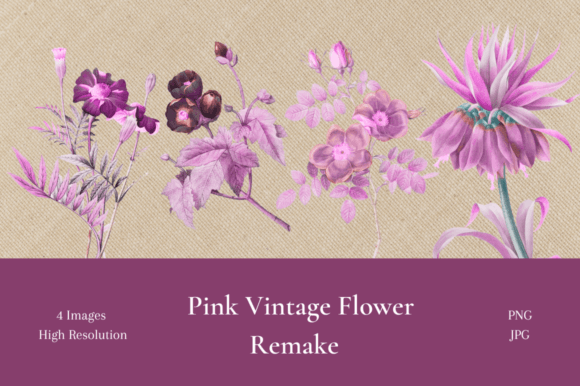
Understanding the Pink Vintage Floral Remake for DIY Design Projects
When you start searching for vintage floral elements to lift invitations, scrapbook pages, or social media graphics, you quickly encounter dozens of styles and file types. One option that surfaces repeatedly is the Pink Vintage Floral Remake — a curated digital set that blends soft antique character with practical modern formats. It isn’t a single image, and it isn’t a subscription. Instead, it typically includes a small collection of high-resolution illustrations, offered as both transparent-background PNGs and white-background JPGs. This article walks through what defines this type of resource, how it stacks up against alternatives, and when it tends to fit a project’s needs—or when something else might serve you better.
What Makes a “Remake” Floral Stand Out
Many floral graphics fall into broad aesthetic buckets: crisp modern vectors, loose watercolor blooms, subdued boho botanicals, or heavily aged ephemera scans. The term remake signals something slightly different. These aren’t raw scans of old book pages or exact replicas of historical textiles. Instead, a Pink Vintage Floral Remake reimagines vintage rose, peony, and spray motifs with a deliberate pink-focused palette, often cleaner than true antique sources but still carrying a soft, nostalgic feel. The linework tends to be refined, the shading gentle, and the composition balanced enough that the elements work as standalone accents or as background fills.
Compared to a literal scanned herbarium print from the 1800s, a remake often feels more versatile for contemporary print design. You avoid the discoloration, crease marks, or brittle edge wear that can look out of place on a modern baby shower invitation. At the same time, it holds more character than a purely flat vector floral icon set. The distinctive trait here is that intentional mashup of old and new — a pink-forward render that works across both paper and digital canvases without needing heavy editing.
Format Choices and Why They Matter
With this particular style, you most often receive three individual PNG files sporting transparent backgrounds, plus three matching JPG versions on a white ground, all at 300 dpi. That dual-format approach influences where and how you can use the artwork. A few quick distinctions:
- Transparent PNGs: These let you layer the florals over any background—kraft paper, pastel washes, gauzy sheer fabric textures—without boxing you into white rectangle borders. Critical for junk journaling collages, save-the-date cards, and social media templates where you want the floral to float above a photo or pattern.
- White-background JPGs: Convenient for a fast start. If your card design already uses a white base or you plan to print directly without a background, JPGs simplify placement. They also avoid any software compatibility quirks that occasionally affect transparent files in very basic editing apps.
Compared to vector formats like EPS or SVG, these raster images are pixel-based. That means you cannot scale them endlessly without quality loss. However, 300 dpi at typical print sizes—say, up to 8x10 inches—produces crisp results. If you need to blow a single flower up to poster dimensions, a vector version of a similar vintage floral might serve you better. But for standard card blanks, scrapbook layouts, and framed wall art under 11x14 inches, Pink Vintage Floral Remake illustrations at 300 dpi generally hold up well without visible pixelation.
Where This Resource Fits Naturally
Creative projects share a few recurring pain points: you want a cohesive suite of visuals that don’t clash, you need flexible file formats for different printers or apps, and you prefer not to spend hours hunting individual assorted elements. A single-themed floral set can solve that. Imagine planning a baby shower with a dusty pink and cream palette. The three distinct designs—perhaps a main bouquet, a corner spray, and a smaller accent bloom—become your consistent thread across the invitation, thank-you tags, menu cards, and even a matching social media announcement. You’re not mixing mismatched roses from various shops, so the final material looks intentional.
Junk journalists and scrapbookers often find value here too. The transparent PNGs slip easily into digital collage templates before printing, or they can be arranged in software, printed once, and then fussy-cut for physical layering. Because the files stay reusable, you can print again later for another project without depleting a stash of physical ephemera. That reusability is a practical distinction from buying a single sheet of vintage stickers or pre-cut die cuts, which are one-time-use by nature.
Comparisons with Similar Vintage Floral Bundle Types
When evaluating the Pink Vintage Floral Remake, it helps to hold it alongside other common options:
- Large digital bundles (30–100+ elements): These cast a wider net. They might include multiple flower types, foliage, borders, and occasionally bonus wreaths. If you need extensive variety for a year of projects, a bigger pack often gives more mileage. The tradeoff? Some large bundles mix styles and quality levels; curation can feel looser. A tightly edited set of three coordinated designs can feel more refined than a sprawling collection where only seven pieces truly match your pink vintage vision.
- Single-category clip art sets (only roses, only wreaths): If your aesthetic revolves solely around cabbage roses, a specialized pack might be ideal. The remake described here typically offers a blend—a mix of focal, corner, and filler pieces that work together but aren’t one-note. That blend suits general stationery better than a set of forty nearly identical blooms.
- Printable paper packs: These come as pre-designed sheets—sometimes with florals already arranged with stripes, shabby textures, or text blocks. They can shortcut the design process further, but they often lock you into someone else’s layout. The PNG approach gives you the raw ingredients to compose your own restricted palette.
- Physical vintage floral paper packs: Nothing replaces the tactile feel of authentic old book pages or real pressed flowers. For pure physical scrapbooking, that might be the right sensory choice. But digital files cost less, take up no storage, and allow exact repeats. Often creators blend both: print the digital remake on tea-stained paper to get a hybrid effect.
Strengths That Support Typical DIY Workflows
A close look at the product description reveals several practical positives. The resolution is print-ready right out of the download. You won’t need to upscale or convert, reducing the risk of jagged edges. The pink vintage palette naturally complements common event stationery color schemes—blush, champagne, sage, cream—so the florals tend to play well with existing wedding or shower templates without forcing a complete color overhaul.
File separation also matters. Because you receive individual PNGs rather than one flattened sheet, you can reposition each flower, resize one without affecting the others, or use just the corner spray on a menu and the central bouquet on a welcome sign. That granular control puts this kind of set above a simple “here is a pretty page” download.
Another strength is quick start-to-finish speed. If you’re assembling a last-minute birthday banner or a thoughtful handmade card, you won’t need to isolate elements or clean up background noise. The remake art typically arrives with clean edges and no stray smudges, which is a timesaver compared to extracting florals from public-domain scans yourself.
Tradeoffs and Where the Limitations Emerge
No single resource fits every creative brief. The fixed pink palette, while versatile within its range, can feel restrictive if you regularly design for gender-neutral parties or prefer autumnal terracottas, deep jewel tones, or bright tropicals. You might find yourself trying to recolor PNGs in editing software, which only gets you so far before the original shading looks off. If your color needs are broad, a set of neutral line art or a multi-color botanical bundle might carry you farther.
The set size—three unique designs—offers cohesion but not depth. For a large wedding suite with dozens of pieces, three illustrations might feel slim. You may need to supplement with coordinating patterns, watercolor washes, or text-focused layouts to keep the visuals from becoming repetitive. In comparison, some designers sell coordinated collections with 12–20 elements built around the same palette, giving more composition options without drifting into mismatched territory.
Scalability is another consideration. Raster files at 300 dpi max out reasonably at medium-large print formats. If you aim to create a wall-sized decal or a large-format poster, vector graphics remain the safer choice. For the typical invitation, journal spread, or frame art, though, this resolution rarely becomes a practical barrier.
When to Choose the Pink Vintage Floral Remake — and When to Look Elsewhere
If you’re planning a pink-centric event, a feminine-branded small business stationery suite, or a cohesive scrapbook spread where three coordinating elements will actually be used and reused, this type of resource makes strong sense. It aligns well with crafters who value fast, pretty, and printable without needing extensive design skills. Download, place, resize, print. That frictionless path can be a genuine relief when deadlines are tight.
On the other hand, if you want to change colors drastically per season, need dozens of distinct floral assets for variety, or plan to use the art for embroidery digitizing or large-scale signage, you may be better served by a more expansive bundle, a vector-based shop, or custom commissioned work. The Pink Vintage Floral Remake is best treated as a spotlight piece for specific projects rather than an all-purpose toolkit.
Think about your real workflow. If you frequently design directly in Canva, Procreate, or Adobe Express, you’ll appreciate the transparent PNGs’ drag-and-drop ease. If you work exclusively in Cricut Design Space and need scalable cut lines, you might hit frustration because these are not cut-ready SVGs. Knowing the end use narrows the choice clearly.
Practical Use Scenarios That Highlight the Real-World Fit
Envision a couple hosting a small garden wedding. They’ve chosen soft pink peonies as their motif. They download the Pink Vintage Floral Remake, drop the bouquet PNG onto a print-your-own invitation template, and use the corner spray on a double-sided menu card. For the thank-you notes, they resize the accent bloom and tuck it beside a heartfelt message. Because they have both file types, they upload the JPG to an online printer for one batch and use the PNG at home for table numbers. This single purchase threads through half a dozen stationery pieces without extra shopping.
For a scrapbook enthusiast documenting a granddaughter’s first year, the same set appears on three different layouts—once as a soft border around a portrait, again as a layered cluster next to journaling, and later printed on vellum for an overlay. The pink vintage tone complements baby photos without overshadowing them. The files stay on the hard drive, ready for next month’s page, unlike a used-up sticker sheet.
These examples point toward a key decision factor: purchases that pay off best are those where you realistically expect to use the identical design in multiple outputs. If you’re a one-project-and-done crafter, a single digital sheet with a standalone composition might feel more economical. But for recurring pink-themed projects, the ability to reprint and recompose adds value.
Weighing Cost Against Creative Flexibility
Digital floral sets in this category usually sit at an accessible price point—often comparable to a single sheet of high-end physical die cuts or a small pack of specialty paper. When you factor in unlimited reuse, that math changes. However, cost-effectiveness depends on usage. If you print the designs once for a single card and forget them, the per-use expense might not beat a ready-printed greeting card from a boutique. The value grows as the files become a go-to element in your creative library.
Time is another hidden coefficient. Cleaning up an image you pulled from a public-domain archive can eat an hour or more; a ready-to-use Pink Vintage Floral Remake removes that prep step. For makers selling small batches of invitations or journal kits, time saved directly affects profitability. Yet if your style leans heavily toward customization and you relish altering every petal shadow, less-polished source material might actually give you more creative room.
Balancing all these factors—format, palette, quantity, resolution, reusability, and speed—leads to a more confident choice. You’re not just asking “Is this pretty?” but “Does this slide into my actual making process and push my project forward?” Asking that question honestly reveals when a curated vintage rose set answers a real need, and when it’s simply a beautiful distraction that won’t get used. There is no universal right pick, only the one that fits the work sitting on your craft desk right now.