Understanding the 120 Watercolor Floral Bundle and How It Fits into Your Creative Toolbox
When you start gathering design assets for stationery, branding, or digital projects, you quickly realize how many choices exist. One option that surfaces repeatedly in creative communities is a large collection of watercolor florals. The 120 Watercolor Floral Bundle aims to offer a broad set of hand-painted-looking elements, from individual blooms to full compositions. But how does it actually compare with buying individual pieces, using subscription libraries, or working with other floral bundles? This article examines what the collection includes, where it shines, where it might fall short, and the kinds of projects where it becomes a genuinely useful resource.
What Is Actually Inside the 120 Watercolor Floral Bundle
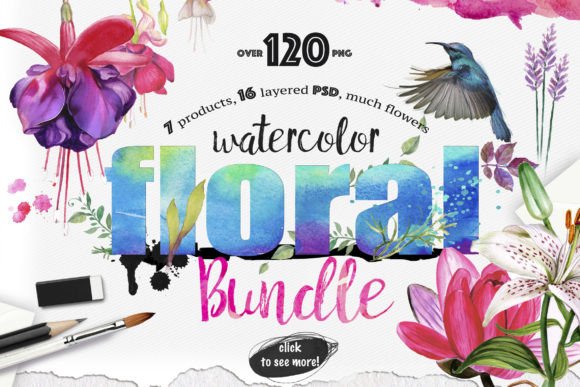
Before comparing options, it helps to look closely at the contents. This particular bundle delivers over 120 graphic elements grouped into several categories. You get roughly 100 individual floral PNG files, covering roses, lilies, calla flowers, fuchsia, violet flowers, and several exotic macro blooms like lotus and lily. There are also wreaths, floral banners, and pre-made designs, many of which come with high-resolution transparent backgrounds. In addition, the package includes 17 watercolor background files, a handful of bird illustrations in PNG format, and some layered PSD files for the pre-made designs and wreaths. The transparent PNGs are especially useful because they integrate into almost any layout without extra clipping work.
This breadth is the core appeal. Instead of hunting down five separate shops for a lily, a wreath, and a background, you get a coordinated set where the artistic style and color palette feel consistent. For many buyers, that coordination reduces the time spent color-correcting or trying to match different artists’ definitions of “watercolor.” Still, it’s worth noting that the bundle’s signature style leans toward soft, romantic, slightly washy florals. If your project calls for crisp, modern, or highly abstract florals, this particular aesthetic may feel too traditional or delicate.
Comparing Collections: Large Bundles vs. Small Curated Sets
One of the first decisions you face is whether to buy a sizable package like the 120 Watercolor Floral Bundle or pick up smaller, more targeted sets. Both paths have distinct tradeoffs.
Large bundles tend to offer a lower cost per element. If you regularly create wedding invitations, greeting cards, or social media graphics that need variety, having a hundred different floral items at your disposal prevents visual repetition. You can use a sprig of calla lilies for one project, a full wreath for another, and a textured background to tie them together, all from the same source. This consistency can build a subtle brand signature across your work.
On the other hand, smaller curated sets—perhaps a pack of 10 roses or a single wreath—let you invest only in what you know you will use. They often carry a higher per-item price, but you avoid file clutter. Some designers find large bundles overwhelming, especially if half the elements don’t match their typical project style. The 120 Watercolor Floral Bundle works best when you genuinely like the core floral varieties included, and when you anticipate needing a range of supporting elements like leaves, branches, and backgrounds, not just a couple of hero flowers.
Watercolor Bundles vs. Single-Element Purchases
A different comparison point is whether to source each floral element individually. Sites that sell standalone watercolor clipart let you pick exactly the flower you need, often with multiple file formats and very high resolutions. If your project demands a specific flower—say, a highly detailed botanical illustration of a lilac—you might find that a specialized single element offers more detail than a bundled version where the same flower appears as part of a larger set.
The 120 Watercolor Floral Bundle is not primarily a botanical illustration collection. Its strength lies in soft, decorative watercolor interpretations rather than scientific precision. The macro exotic flowers such as lotus and calla lilies have a dreamy quality that suits invitations, poetry book covers, and spa branding. But if you need florals for a field guide or a design where botanical accuracy is the selling point, a bundle of this nature may feel insufficiently precise. In that case, buying individual, high-definition botanical elements from a specialist might yield better results, even if it costs more overall.
Conversely, when you have a tight deadline and need a wedding suite layout finished quickly, the bundle’s pre-made designs and wreaths can act as ready-made focal points. You can drop in a complete watercolor wreath, add typography, and have a finished invitation in minutes. That speed justifies the collection for many small business owners, even if they later supplement it with one or two unique elements purchased separately.
Evaluating Subscription Services Versus One-Time Bundles
An increasingly common alternative is the subscription model, where you pay monthly or annually for access to a huge library of assets. Subscriptions provide enormous variety and frequently updated content. They can expose you to different art styles without additional per-item fees. However, they also represent a recurring cost that accumulates over time.
A one-time purchase like the 120 Watercolor Floral Bundle sits on your hard drive permanently. You are not locked into a payment plan, and you don’t lose access if you cancel. For occasional users—someone who designs three or four event invitation suites per year, or a blogger who creates seasonal featured images—the bundle may be more economical than twelve months of subscription fees. It also gives you offline access, which can be important during travel or in locations with spotty internet.
Yet subscriptions win when you need fresh assets across many styles beyond watercolor florals. If your work also requires vector icons, lifestyle photography, and abstract textures, a broad library might serve you better than a single floral-focused download. The decision often comes down to the proportion of floral versus non-floral work you produce. Designers whose projects are 70% floral-themed often find that a dedicated bundle plus free assets for other categories is more cost-effective. Those whose work is only 20% floral may be better served by using a subscription and downloading just a few watercolor items when each project arises.
Quality and File Format Considerations
File formats influence how you can use any resource. The 120 Watercolor Floral Bundle provides PNG files with transparent backgrounds, which suit most raster-based workflows: Canva, Photoshop, Affinity Photo, and any document where you need to layer elements over colored backgrounds without a white box. The inclusion of PSD files for wreaths and pre-made designs adds flexibility for those who want to rearrange individual leaves or adjust layering before exporting. This is a practical bonus that not all bundles include.
However, raster PNGs have resolution limits. If you plan to print designs at very large sizes—say a billboard or a wall mural—you need to check the pixel dimensions. Watercolor elements often have subtle transparency and soft edges that can lose quality if upscaled aggressively. Vector formats like AI or SVG would be ideal for infinite scalability, but this bundle, like many watercolor collections, is raster-based because true watercolor textures are inherently pixel-oriented. Most users find the provided resolutions sufficient for standard print sizes up to A3 or tabloid, but you should verify dimensions if your work skews toward large-format printing.
Comparing this with vector floral bundles reveals a clear divide. Vector florals are easier to resize and recolor globally, but they rarely capture the nuanced washes and paper textures of real watercolor. The choice depends on whether you prioritize organic, painterly feel or maximum editability and scalability. Many stationery designers prefer the rich, tactile look of raster watercolor for small to medium prints, accepting the resolution ceiling as a fair trade.
Where the Bundle Performs Best
Several project types align naturally with what this collection offers. Wedding and event stationery is the most obvious fit. Soft pink roses, blush backgrounds, and delicate wreaths match the visual language of countless invitation suites, save-the-date cards, menus, and place cards. The bird illustrations add a whimsical touch that works for garden weddings or spring events. Having all these elements in one place streamlines the design process, especially when you are creating a coordinated suite where every piece must feel related.
Branding for beauty, wellness, or lifestyle businesses also benefits. A small-batch soap maker, a florist, or a yoga studio can use the floral motifs, backgrounds, and wreaths to build a cohesive visual identity across packaging, social media posts, and business cards. The watercolor aesthetic communicates a handmade, natural quality that resonates with customers seeking artisan products.
Additionally, crafters who design their own printables, scrapbook pages, or party decorations often find the bundle’s variety energizing. Instead of reusing the same three roses on every sticker sheet, you can rotate through dozens of blooms, keeping your product line fresh. The backgrounds serve as soft overlays or paper textures, while the wreaths frame text beautifully for quote graphics or table signs.
When the Bundle May Not Be the Ideal Choice
Recognizing the limitations helps you avoid mismatched purchases. First, if your brand aesthetic leans heavily toward bold, geometric, minimalist, or ultra-modern styles, the loose, romantic watercolor look may clash. Forcing these florals into a stark, contemporary layout can create visual dissonance. In such cases, line-art botanicals or solid-color vector flowers often integrate better.
Second, if your commercial work requires exclusive, never-before-used assets, a bundle that is sold broadly may not offer the uniqueness you need. While you can customize colors and compositions, the underlying elements are shared across many other buyers. This rarely matters for local businesses or small-scale products, but a high-end perfume brand launching a global campaign might need custom illustration to guarantee exclusivity.
Third, if you only need one specific element—say, a single wreath for a logo—the bundle’s volume might be wasteful. Spending less on a standalone wreath file from the same artist or a similar style would be more efficient. The bundle’s value lies in its range, and that value diminishes if you ignore 90% of the contents.
Practical Steps for Making the Most of a Large Bundle
If you decide that the 120 Watercolor Floral Bundle matches your needs, a few organizational practices can prevent overwhelm. Start by sorting the files into subfolders: individual blooms, leaves, wreaths, backgrounds, and pre-made designs. Within the blooms folder, you might further categorize by flower type. This makes it faster to find a pink rose versus a violet sprig when you are designing under a deadline.
Experiment with blending modes and opacity adjustments on the backgrounds to create subtle texture overlays that don’t overpower your text. The wreath PSD files allow you to extract individual flowers and rearrange them into new shapes—a half wreath, a corner cluster, or a vertical spray. This effectively increases the number of usable compositions beyond the 120 listed items.
Consider the color palette of your project early on. Watercolor elements are harder to recolor globally than vector art, but you can adjust hue, saturation, and lightness in Photoshop or similar software to shift pink roses toward a peach or coral range. This broadens the bundle’s adaptability without requiring a new purchase.
How the Selection Compares Across Different Price Points
In the landscape of watercolor design assets, pricing varies widely. Free resources exist but often come with lower resolution, limited commercial rights, and generic compositions. Premium one-off elements from professional illustrators can cost $10–$50 per item. The 120 Watercolor Floral Bundle typically sits in a middle ground—affordable enough that small businesses see quick return on investment, yet comprehensive enough to rival much more expensive collections.
When you break down the per-element cost, bundles generally offer significant savings over individual purchases. However, price should not be the only factor. A bundle that saves you $50 but whose style you only tolerate might cost you more in time spent adapting files or in artwork that fails to attract clients. On the flip side, if the style aligns with your brand, the bundle becomes a low-cost foundation for years of projects.
Making the Right Choice for Your Workflow
The decision ultimately rests on three questions: Do you frequently create floral-forward designs? Does the soft, romantic watercolor look fit your typical project style? And do you prefer to have an extensive ready-made library rather than sourcing assets piece by piece? If you answer yes to all three, the 120 Watercolor Floral Bundle moves from “nice to have” to a practical workhorse asset.
If your needs are occasional, or your style leans away from this aesthetic, you might achieve better results with smaller curated purchases, subscription access, or even learning to create your own watercolor textures. There is no universal correct answer, only the one that best fits your project demands, budget, and creative preferences. By weighing the bundle’s contents against your typical assignments, you can decide whether its particular combination of blooms, backgrounds, and ready-to-use designs aligns with the visual stories you want to tell.